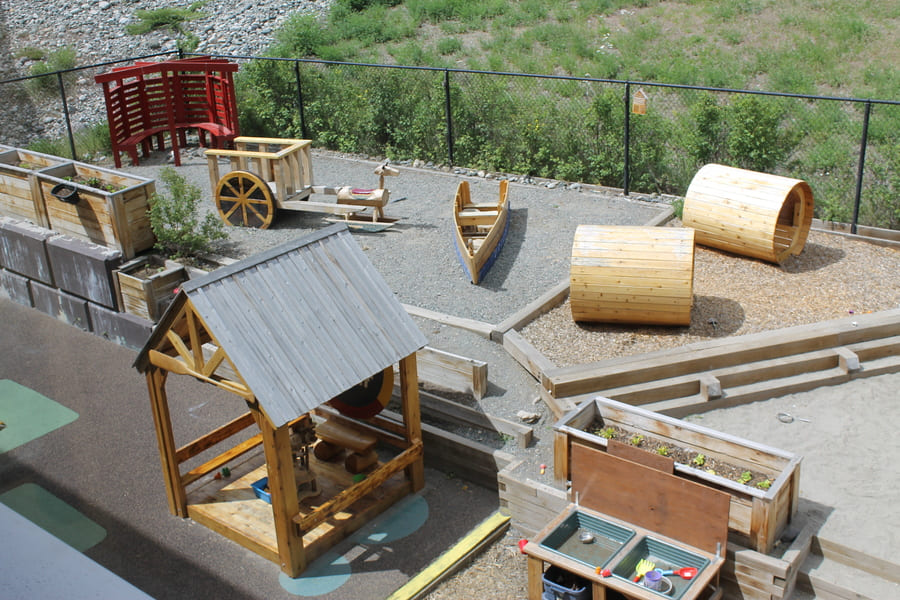
Teaching the next generation
OVERVIEW
The Indigenous Early Childhood Education (IECE) program at NVIT prepares learners to provide quality care and education for young children while honouring Indigenous ways of knowing and being. The program integrates Indigenous worldviews with contemporary child development practices and provincial licensing standards, supporting culturally grounded and responsive early learning.
Certificate
The Indigenous Early Childhood Education Certificate equips learners with foundational skills and knowledge to support young children, families, and communities. Learners are encouraged to examine the roles of the child, family, and educator through concepts of belonging, learning, and sharing that strengthen identity through culture. The program recognizes that Indigenous approaches to child development have continually evolved alongside societal and regulatory contexts. Learners reflect on how the image of the child has shifted over time and how Indigenous ways of knowing and being are upheld within British Columbia’s licensed childcare framework.
Diploma
The IECE Diploma is designed to meet provincial licensing standards for Infant and Toddler Educator and Special Needs Educator accreditation. The program ensures both academic and First Nations standards are met, preparing graduates to be effective early childhood educators and childcare professionals in British Columbia.
Successful completion allows graduates to work as supervisors in daycare settings, support children with special needs, and work with infants and toddlers under three years of age.

ADMISSION REQUIREMENTS
Certificate Applicants:
- Grade 12 graduation, Mature Student status, or equivalent;
- English 12 or English Studies 12 or English First Peoples 12 or ENGL 060, or equivalent;
- A professional letter of reference, preferably from an individual working in the field of education or childcare.
Diploma Applicants:
- IECE/ECE Certificate from NVIT or another post-secondary institution;
- Immunization Record form for IECE (Upon request from NVIT);
- A professional letter of reference from an individual working in the childcare, education, or special needs field.
Additional Requirements for Practicum Placement
- Standard First Aid with CPR Level C;
- BC Food Safe Level 1;
- Immunizations (as required by Practicum sites and recommended by BC Centre for Disease Control, 2024): diphtheria and tetanus, polio, hepatitis B, measles, mumps & rubella (MMR), varicella, pertussis. (From BCCDC Guide) COVID-19 vaccination is recommended for HCWs to reduce worker illness during periods of high SARSCoV-2 circulation in the community and to reduce transmission of SARS-CoV-2 to vulnerable individuals receiving health care, personal care or home support in hospital or community settings.
-
- Please share your COVID-19 and Influenza vaccination status and provide supporting documentation if you have received your annual doses. If you cannot provide proof of these vaccinations, you will need to follow the protocols set by your clinical/practicum placement. These may include measures such as wearing a mask or completing a disclosure report.;
-
- Ministry of Public Safety and Solicitor General Criminal Record Check Clearance for Vulnerable Sector (RCMP Checks will not be accepted).
- Must have transportation in order to travel to practicum placements that are throughout the Nicola Valley and Thompson Regions.
NVIT is committed to ensuring education is accessible to all people. Students who do not meet program requirements should contact the Department Coordinator or an NVIT Academic Planner regarding upgrading opportunities.
COURSE REQUIREMENTS
| Certificate | ||
| Course Code | Course Title | Credits |
| ENGL 110 | English Composition | 3.00 |
| PSYC 131 | Applied Interpersonal and Career Development | 3.00 |
| IECE 101 | Child Health and Wellness | 3.00 |
| IECE 102 | Introduction to Indigenous Early Learning and Care | 3.00 |
| IECE 103 | Stories, Ideas, and Pathways of Child Development | 3.00 |
| IECE 104 | Pathways of Development | 3.00 |
| IECE 124 | Introduction to Designing Children’s Environments | 3.00 |
| IECE 134 | Guiding Through Gifts in Indigenous Early Years | 3.00 |
| IECE 148 | Practicum I: Connecting Theory and Practice | 3.00 |
| IECE 125 | Designing Children’s Programs | 3.00 |
| IECE 126 | Programming for Early Years | 3.00 |
| IECE 136 | Connectedness to Culture and Community | 3.00 |
| IECE 149 | Practicum II: Practicing Competencies | 3.00 |
| IECE 150 | Practicum III: Demonstration | 6.00 |
| Diploma | ||
| Course Code | Course Title | Credits |
| IECE 204 | Early Years Development III | 4.00 |
| IECE 214 | Indigenous Culture in Early Learning Environment | 3.00 |
| IECE 216 | Administrative Licensing and Leadership | 3.00 |
| IECE 224 | Programming for Early Years II | 3.00 |
| IECE 260 | Infant and Toddler Practicum | 6.00 |
| IECE 208 | Developing Inclusive Early Childhood Settings | 3.00 |
| IECE 210 | Working with Families | 3.00 |
| IECE 226 | Natural Environments in Child Care | 3.00 |
| IECE 234 | Guidance for Early Years II | 3.00 |
| IECE 265 | Special Needs Practicum | 6.00 |
CAREER PATHWAYS
Completing the IECE Diploma will provide an opportunity to Manage and oversee the following:
- Aboriginal Head Start Programs
- Strong Starts
- Daycare Centres
- Inclusive Support Programs
- Early Childhood Centres
- Family Daycares
LOOKING FOR TUITION SUPPORT?
Learn about scholarships, bursaries, grants, student loans, and entrance awards available to help with tuition.
CHOOSE PROGRAM
Browse through our programs to see what we offer. For admission requirements inquiries, book an appointment with a Recruiter.
RECEIVE A LETTER
You will receive either a Conditional Offer Letter or a Full Offer Letter by email from the Registrar’s Office.